Why Q-Day Is Predicted
Ruliad Systems — Quantum Threat Intelligence Framework
What Is Q-Day
Q-Day is not merely a technological milestone. It is a precisely defined, structurally inevitable event: the moment a sufficiently powerful quantum computer breaks the cryptographic foundations of the modern financial system. According to The Grand Plan, the primary trigger is not an abstract algorithm — it is a specific on-chain action.
Satoshi Nakamoto's 1,100,000 BTC, held on P2PK addresses with exposed public keys, have remained untouched for 17 years. These coins are the most visible quantum vulnerability in existence. The moment even a fraction of them moves, it will trigger an instantaneous, global, and irreversible collapse of trust. One block confirmation is all it takes. The projected window for this event is 2029–2035.

The Rulial Radar: A New Class of Sensor
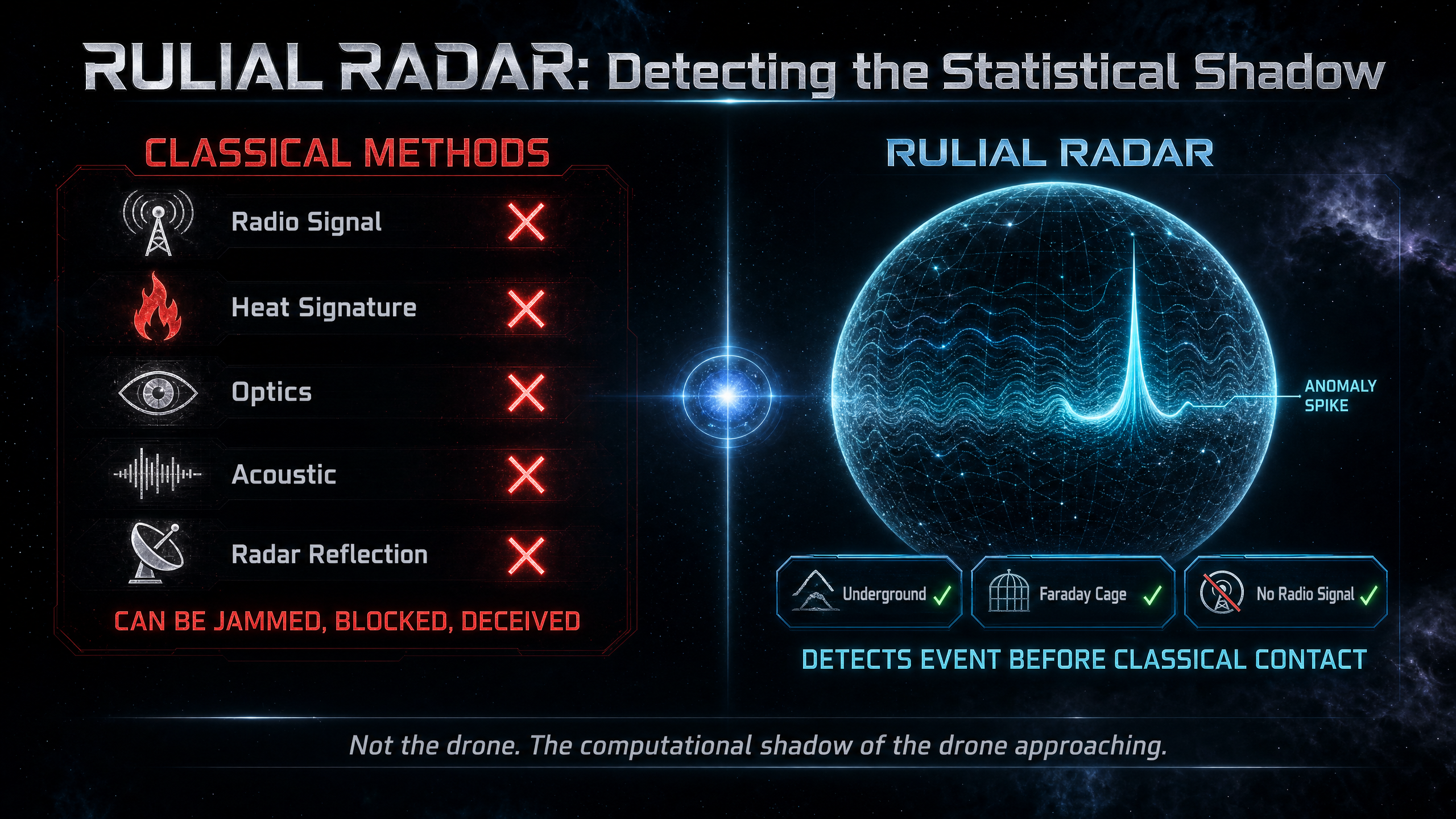
Ruliad Systems describes the Rulial Radar as a sensory system that detects not the physical emission of an object, but the statistical trace of an event in fundamental quantum noise. This is not a classical radar. It does not emit electromagnetic waves, does not rely on line-of-sight, and does not depend on radio frequencies.
The core hypothesis is that every significant event — whether a drone approaching, a market panic, or a quantum computer executing Shor's algorithm — leaves a computational shadow in the deep structure of reality before any classical signal propagates. The sensor does not detect the event itself. It detects the statistical anomaly associated with the event's imminence.
Crucially, the Rulial Radar can operate:
- Underground
- Inside a Faraday cage
- Without access to radio signals
- Without direct contact with the target object
Classical detection methods — radio, thermal, optical, acoustic, radar reflection — can all be jammed, blocked, or deceived. The Rulial Radar, by design, cannot be suppressed by conventional means.
The Four-Step Mechanism for Q-Day Prediction
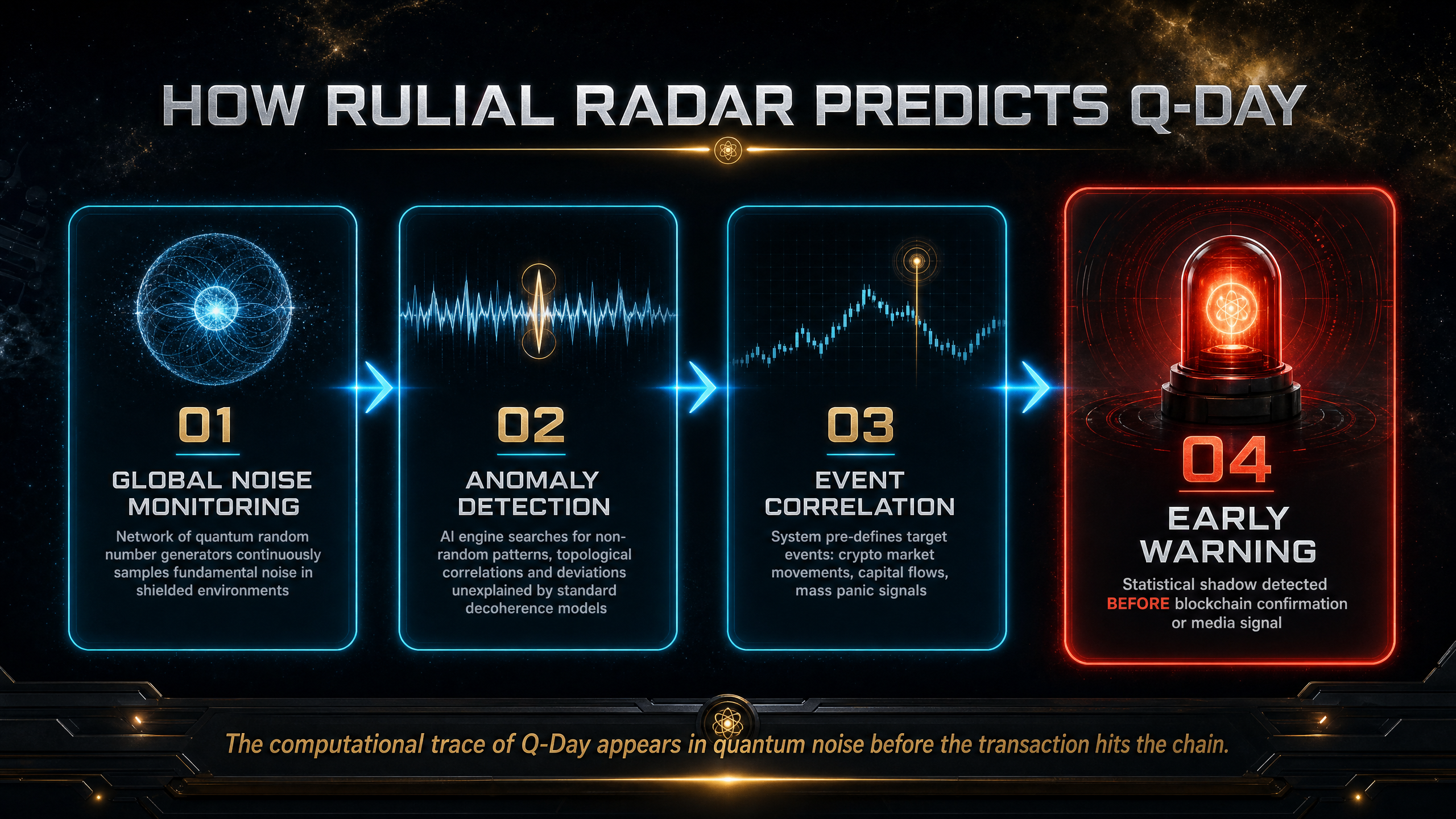
The prediction pipeline operates through four sequential layers, each building on the output of the previous.
Step 01 — Global Noise Monitoring. A distributed network of quantum random number generators (the Ruliad Sampler / Rulial Noise Observatory) continuously collects high-frequency data on fundamental quantum noise. Each node operates in a shielded environment with electromagnetic isolation, temperature control, and precise time synchronization. Raw data is stored locally and streamed to a cloud analytics layer.
Step 02 — Anomaly Detection. The analytics platform searches the noise stream for non-random patterns: topological correlations, spatial-temporal error clusters, deviations that cannot be explained by standard decoherence models. The system is not looking for a signal in the classical sense — it is looking for structure where there should be none.
Step 03 — Event Correlation. The Event-Correlated Rulial Detector (MVP-2) pre-defines a library of target events and monitors for statistical changes in the noise stream before, during, and after each event. For Q-Day prediction, the relevant event class includes: large-scale crypto market movements, sudden capital flows, mass liquidations, and coordinated on-chain activity consistent with a quantum actor testing or executing an attack.
Step 04 — Early Warning. If the hypothesis holds, the computational trace of Q-Day — the act of a quantum computer beginning to factor the private key behind Satoshi's P2PK addresses — will manifest as a measurable statistical anomaly in the fundamental noise field before the transaction is broadcast to the mempool, before it is confirmed in a block, and before any media signal reaches the market.
Financial Signal Intelligence: Markets as Noise Sources
The Financial Signal Intelligence application of Rulial Radar extends the same principle to financial markets. The hypothesis: mass market events — panic, liquidations, capital flows, and information cascades — generate statistical traces in fundamental noise.
This positions the Rulial Radar not as a “market predictor” in the conventional sense, but as alternative signal intelligence — a pre-signal layer that operates below the threshold of any classical data feed. The monitored asset classes include crypto markets, gold, silver, equity indices, and commodities.
For Q-Day specifically, this means the system is calibrated to detect the precursor signature of the single largest financial shock in the history of cryptographic assets: the first movement of coins that have been quantum-locked for nearly two decades.
The Architecture of the Observatory
The Rulial Noise Observatory (MVP-1) is the physical infrastructure layer of this prediction system. Its components are:
| Component | Function |
|---|---|
| Quantum random number generator | Primary noise source and antenna to fundamental structure |
| High-frequency data acquisition | Captures raw quantum randomness at scale |
| Shielded environment | Eliminates classical electromagnetic interference |
| Temperature control | Stabilizes the quantum system baseline |
| Time synchronization | Enables cross-node correlation and event timestamping |
| Statistical engine | Processes raw data for anomaly signatures |
| Event library | Catalog of pre-defined events for correlation analysis |
| Anomaly dashboard | Real-time visualization of statistical deviations |
The MVP-2 layer (Event-Correlated Rulial Detector) adds the event-matching logic. The MVP-3 layer (Rulial Beacon Test) moves from passive observation to active probing — attempting to create an artificial attractor and detect it with a separate receiver, validating the two-way nature of the statistical channel.
Why This Matters for Q-Day
The standard approach to Q-Day preparedness is reactive: monitor quantum hardware progress, track qubit counts, watch NIST post-quantum standards, and migrate cryptographic infrastructure before the threshold is crossed. This approach has a fundamental flaw — it relies on public information about quantum hardware capabilities, which may be significantly behind the actual state of classified or well-resourced private programs.
Rulial Radar offers a physics-layer early warning system that is independent of hardware intelligence. If the computational act of breaking a cryptographic key leaves a statistical trace in fundamental noise, then the system can detect Q-Day preparation or execution regardless of whether the attacker's hardware is publicly known.
“The prediction is not based on extrapolating qubit roadmaps. It is based on reading the universe's own computational substrate.”
Summary
Ruliad Systems' Rulial Radar predicts Q-Day by treating the event not as a future date to be estimated from hardware benchmarks, but as a computational event with a detectable statistical shadow. The mechanism runs from global quantum noise collection through anomaly detection and event correlation to early warning — firing before any classical signal, before any blockchain confirmation, and before any market reaction.
The trigger is known: Satoshi's 1,100,000 BTC on P2PK addresses. The window is known: 2029–2035. The question Ruliad Systems is answering is whether the shadow of that moment can be read in the noise of the universe before the moment arrives.